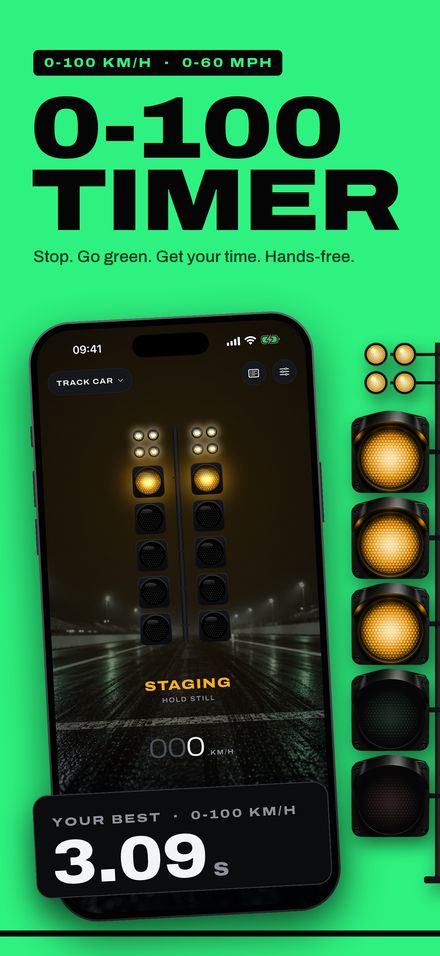
The 0-100 timer that's actually accurate. Stop, the tree goes green, launch — every split times itself.
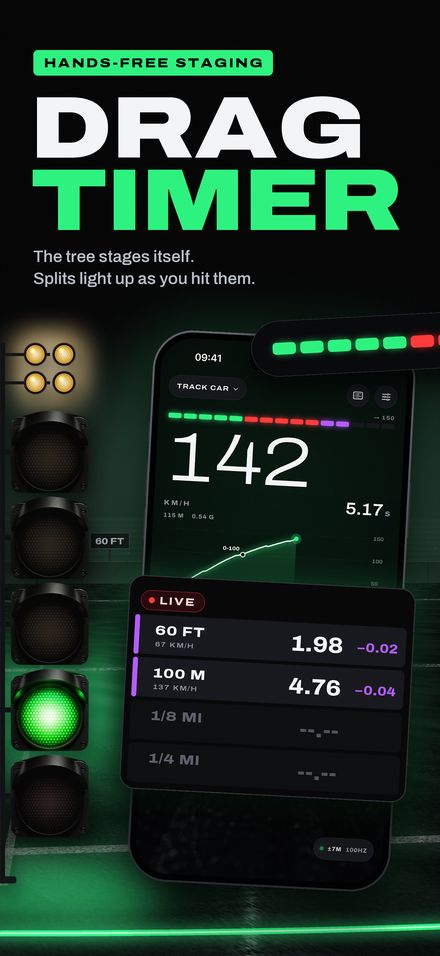
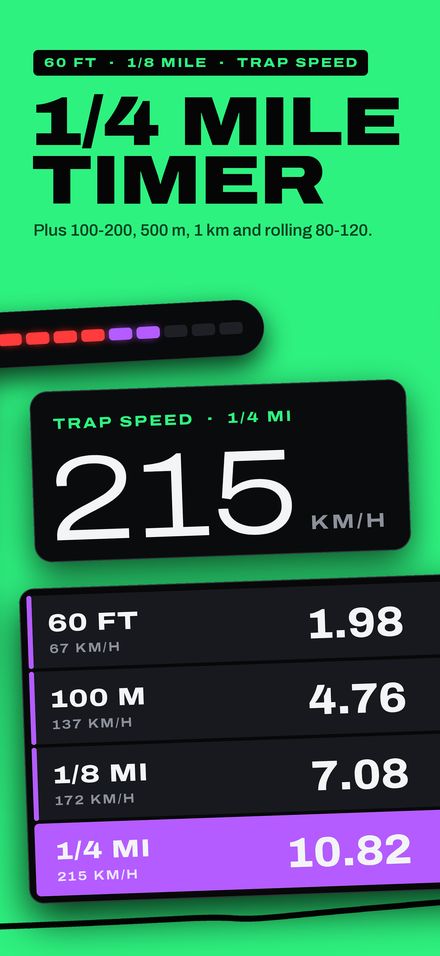
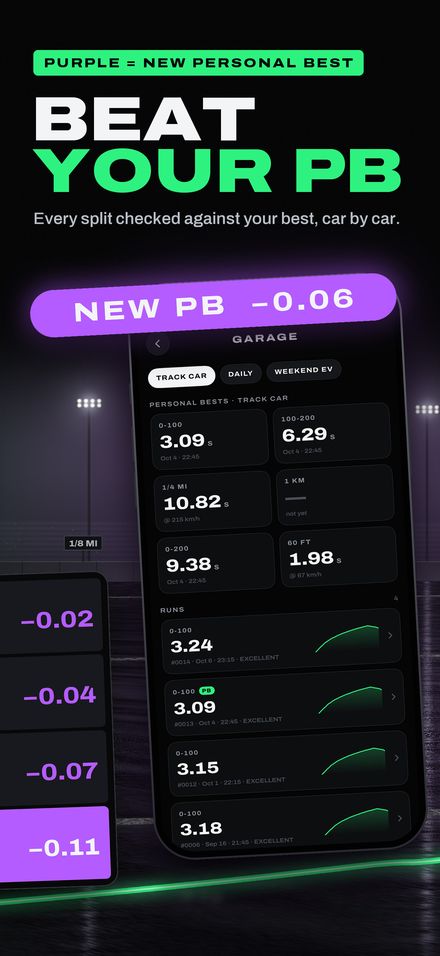
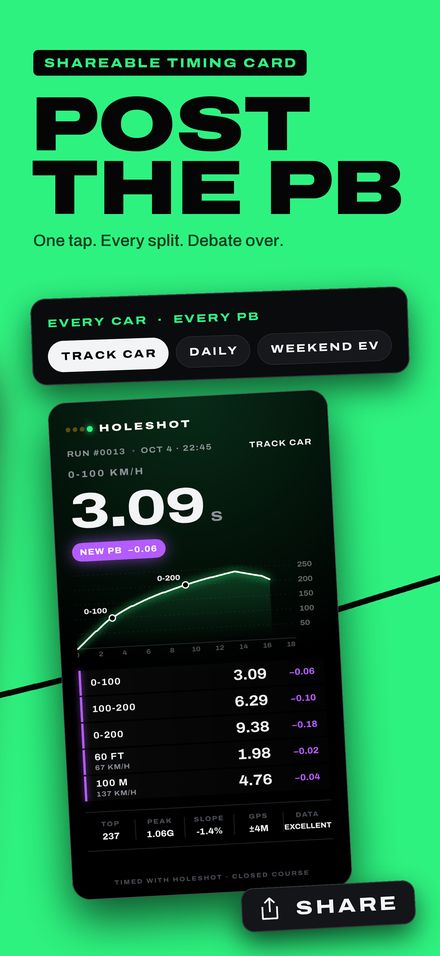
0-100, 100-200, 60 ft, 100 m, 1/8 and 1/4 mile, 500 m, 1 km — timed on the same run, with trap speeds. Each split lights up the moment you hit it, compared with your best: purple when you just got faster.
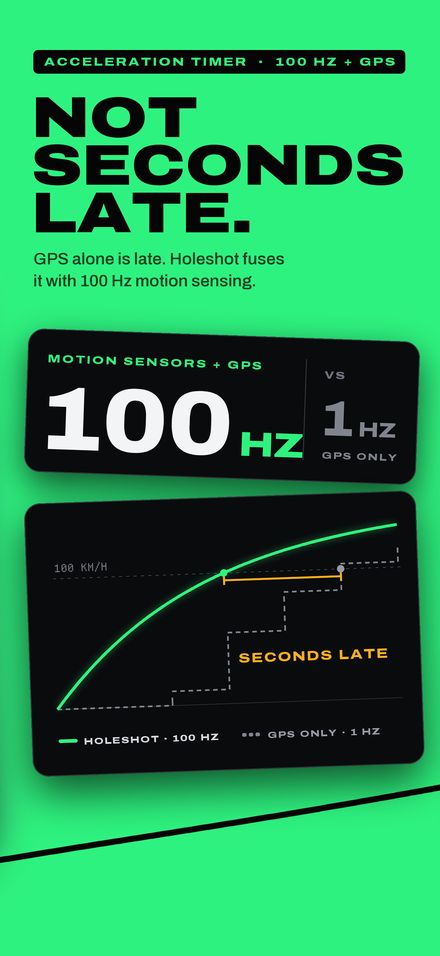
Phone GPS reports about once a second, and late. Timers that use it alone start the clock late and read your splits off stale data — which is why their 1★ reviews all say the same thing. Holeshot reads the motion sensors 100 times a second, catches the launch the instant you move, and checks the whole run against every GPS fix — including this phone's own GPS delay, which it learns.
*300 simulated runs with realistic phone-sensor faults. A GPS-only timer on the same data: 0.6 s typical error, over 2 s on one run in twenty.
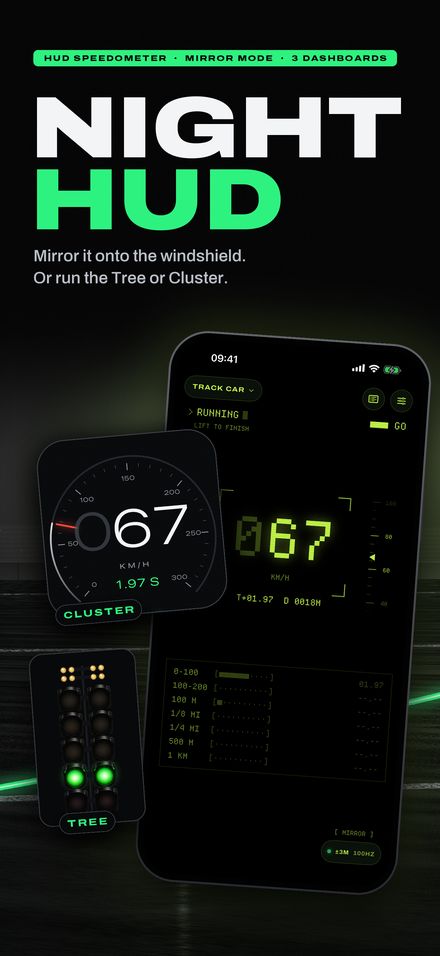
A staging tree that goes green when you're stopped. Rev lights counting to the next milestone. A live speed trace. A timing card worth posting. Three dashboards — Christmas Tree, Cluster and Night HUD, with a mirror mode for the windshield.


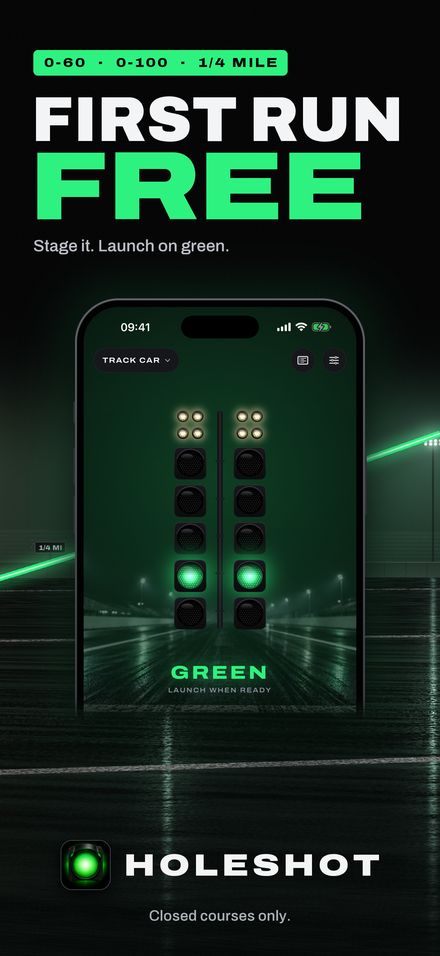
Come to a stop. The pre-stage and stage lights come on, the ambers fill while Holeshot confirms you're steady — then green. There's no countdown: launch whenever you want. The clock starts on the first movement and the run ends when you lift. Your phone stays in the mount.
Holeshot is a timing tool for drag strips, track days and private closed roads. There are no public speed leaderboards — your runs are yours. Obey the law.
Phone GPS reports about once a second and late. Here is exactly why GPS-only timers read slow, start late, and miss spli…
A step-by-step guide to timing your car's acceleration with an iPhone: mounting, staging, launching, and reading the res…
Rollout is the first foot of movement that drag strip timers and US car magazines leave out. It typically makes a 0-60 m…
Pre-stage, stage, three ambers, green and red: how the drag strip starting lights work, the difference between a Sportsm…
In drag racing, the holeshot is winning off the start line: reacting and launching better than the other lane, even with…
The 60-ft time measures the first 60 feet of a drag run. It is the clearest read on your launch, and every tenth there i…
Holeshot fuses the iPhone's 100 Hz motion sensors with GPS, so the clock starts the instant the car moves and the speed curve isn't limited by GPS's once-a-second updates. In our test suite of 300 simulated runs with realistic phone-sensor faults, 0-100 km/h times were within 0.09 s of the truth 95% of the time. Real-world accuracy also depends on a firm mount and a clear view of the sky.
Standing start: 0-50, 0-100, 0-150, 0-200 km/h (or 0-30, 0-60, 0-100, 0-130 mph), 100-200 km/h, 60 ft, 100 m, 1/8 mile, 1/4 mile, 500 m, 1/2 mile, 1 km and 1 mile with trap speeds. Rolling: 80-120, 60-100, 100-200 km/h and 60-130, 40-70 mph. Plus top speed, peak g and road slope.
No. Stop the car and the tree stages itself. When it goes green, launch whenever you're ready — the clock starts on the first movement and the run ends when you lift.
No. Holeshot uses only the iPhone's own GPS, accelerometer, gyroscope and barometer.
Your first run is free. Holeshot Pro is $3.99 a week, $11.99 a month with a 3-day free trial, or $45.99 a year.
On closed courses: drag strips, track days and private roads. Never on public roads.